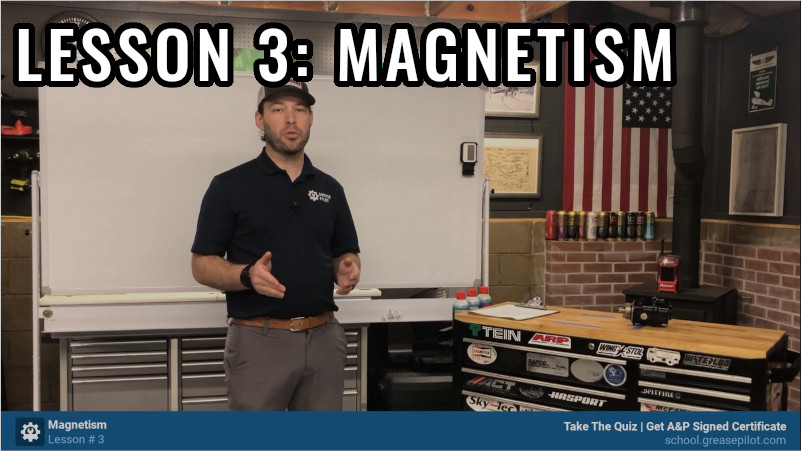
In short: Magnetism is the property of a material to attract ferrous metals such as iron, steel, and alnico. The FAA covers it in the Aviation Maintenance Technician Handbook — General (FAA-H-8083-30B), Chapter 12. As an A&P mechanic you'll find magnetism almost everywhere on the aircraft — in magnetos, generators, alternators, starters, and solenoids.
Frequently Asked Questions
What is magnetism in aircraft maintenance?
Magnetism is the property of a material to attract ferrous metals such as iron, steel, and alnico. In aviation it shows up almost everywhere — magnetos, generators, alternators, starters, solenoids, and the magnetic compass.
What are the three types of magnets?
The three types are natural magnets (lodestone — weak and mostly historical, not used in aviation), permanent magnets (artificially magnetized, retain their magnetism, used in magnetos), and electromagnets or temporary magnets (a magnetic field created by current flowing through a coil around a core, which can be switched on and off).
Which materials are magnetic?
Ferromagnetic materials — iron, steel, and iron alloys such as soft iron and alnico — are strongly attracted and can be magnetized. Nickel, cobalt, and gadolinium are magnetic to a limited degree. Everything else is essentially non-magnetic, and a few substances are diamagnetic, meaning they are weakly repelled by both poles of a magnet.
How does an electromagnet work?
When current flows through a conductor it creates a magnetic field around that conductor. Coiling the wire concentrates the field, and adding a soft iron core multiplies its strength. The field strength depends on the amount of current, the number of turns of wire, and the core material — and the field disappears when the current stops, leaving only a small amount of residual magnetism.
Why does the FAA test A&P mechanics on magnetism?
Because magnetism is the working principle behind so many aircraft components — magnetos, motors, generators, alternators, solenoids, and the compass. Understanding poles, flux lines, the three types of magnets, and the right-hand motor rule (ACS subjects AM.I.A.K2 and AM.I.A.K7f) gives you the foundation to troubleshoot the electrical and ignition systems you'll work on in the field.